The White House: Burned Once, Gutted Once, Rebuilt for a Third Century
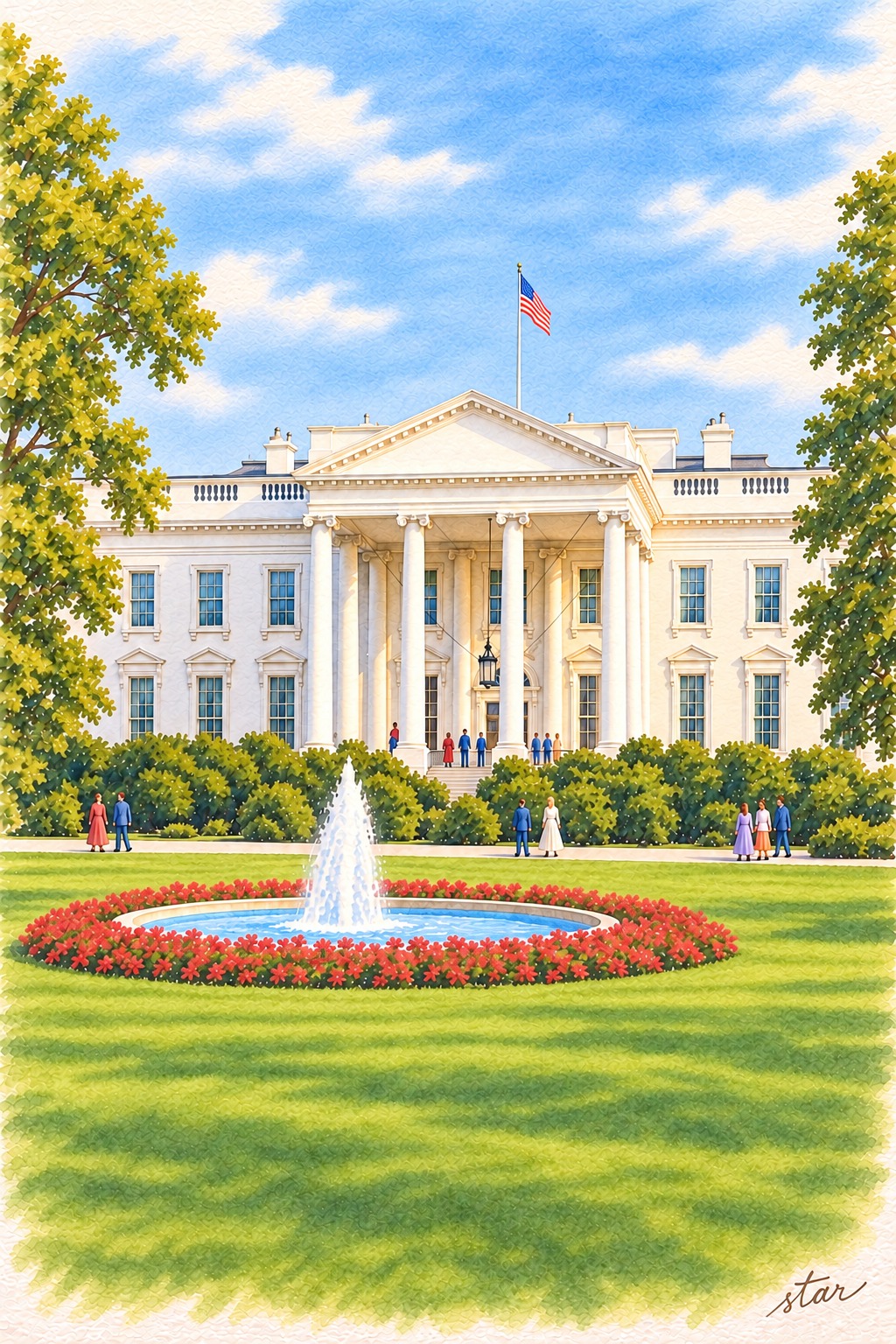
Original watercolour art illustration by Solomon Rokowsky.
The Residence Act of 1790 put the permanent capital on the Potomac, and Washington and Jefferson chose the President's House by public competition. The winner was James Hoban, an Irish-born, Dublin-trained architect working in Charleston; Washington had admired his Charleston County Courthouse on his Southern tour, and summoned him to Philadelphia in June 1792. Hoban's design - a restrained neoclassical house drawing on Palladio and, on the upper floors, Dublin's Leinster House - was far smaller than L'Enfant's palace dream. The cornerstone was laid at noon on October 13, 1792. Enslaved African-Americans quarried the stone; Scottish masons raised the sandstone walls; the whole house cost $232,371.83. The porous sandstone got its famous color from a whitewash of lime, rice glue, casein and lead.
John Adams moved in on November 1, 1800, while plaster was still wet, and wrote to Abigail the next morning: "May none but honest and wise men ever rule under this roof" - Franklin Roosevelt later had the blessing carved into the State Dining Room mantel. People called it the "White House" by 1811, but the name was only made official in 1901, by Theodore Roosevelt.
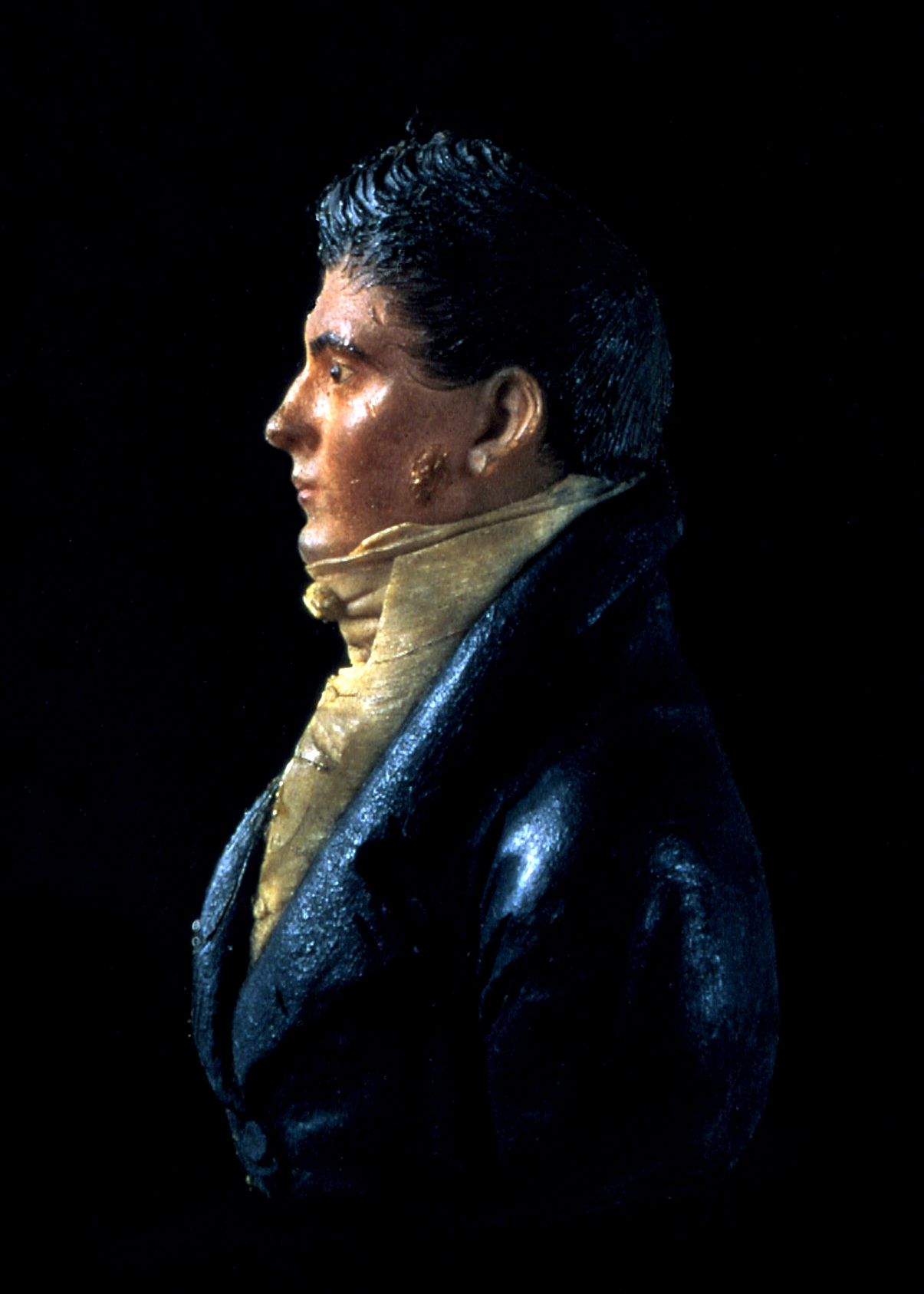
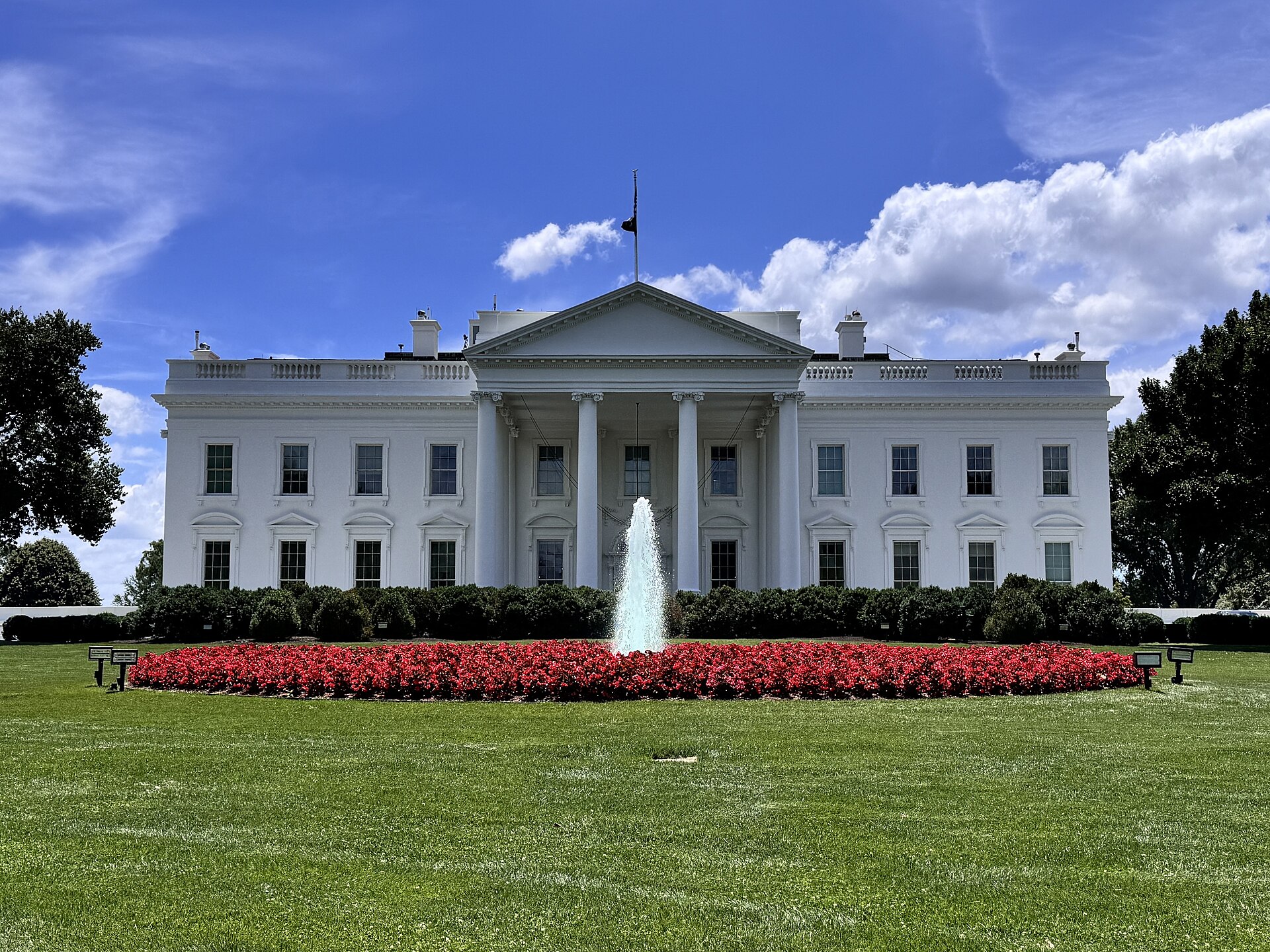
The south portico and lawn in June 2024. Photo: DJTechYT, CC BY-SA 4.0, via Wikimedia Commons. Resized.
1814: the burning
On August 24, 1814, British troops put the house to the torch during the Burning of Washington, in retaliation for American destruction in Canada. Before fleeing, Dolley Madison famously refused to leave without the full-length Gilbert Stuart portrait of George Washington - the Lansdowne portrait was saved; almost everything else was not. Only the scorched exterior walls remained, and most of them had to be taken down. Hoban returned to rebuild from 1815 to 1817, and later added the two porticos: the south in 1824, the north in 1830, with stonework carved by Italian artisans brought over for the Capitol.
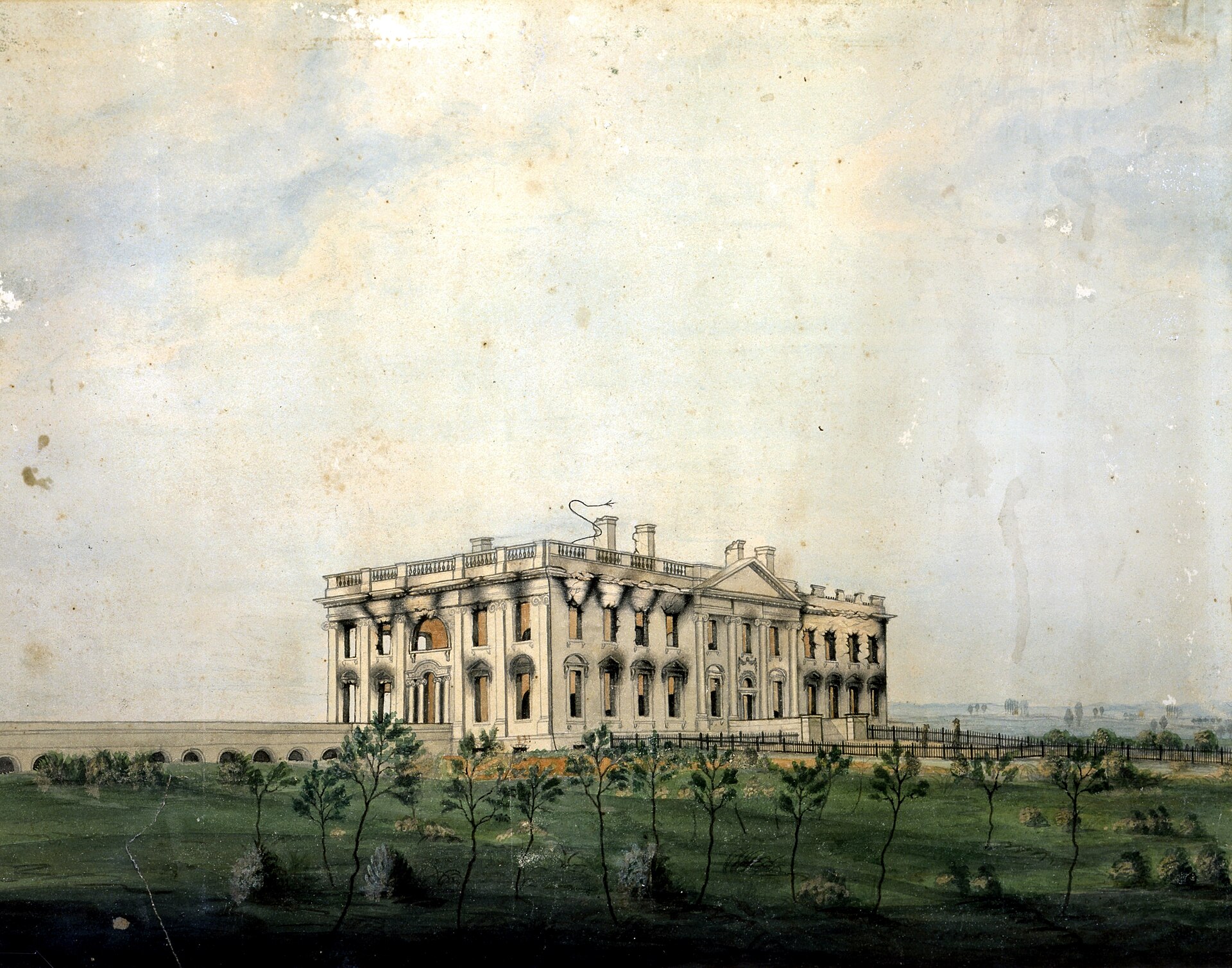
George Munger's watercolour of the burned-out President's House, 1814-1815. Public domain, via Wikimedia Commons. Resized.
Wings, fire and a full gutting
Theodore Roosevelt's 1902 renovation by McKim, Mead & White stripped out the Victoriana and built the West Wing for the executive staff. William Howard Taft added the first Oval Office in 1909; Franklin Roosevelt moved it to its present corner by the Rose Garden in 1934. The West Wing itself burned on Christmas Eve 1929. By 1948 the old house - timber-framed behind its sandstone, weighed down by 150 years of additions - was declared in imminent danger of collapse. Harry Truman moved across the street to Blair House, and from 1949 to 1952 the interior was completely dismantled: a new steel skeleton went up inside the old walls, and the historic rooms were rebuilt within it, at a cost of about $5.7 million. Some of the original timbers survive as paneling in the ground-floor rooms.
Jacqueline Kennedy then turned the rebuilt shell into a museum-grade house. With curator Lorraine Pearce, collector Henry Francis du Pont and Paris designer Stephane Boudin, she gave each state room a documented period style, founded the White House Historical Association, and showed the result to the country in a televised tour on Valentine's Day 1962. Congress had already declared the White House a museum in September 1961, protecting its furnishings from future auctions.
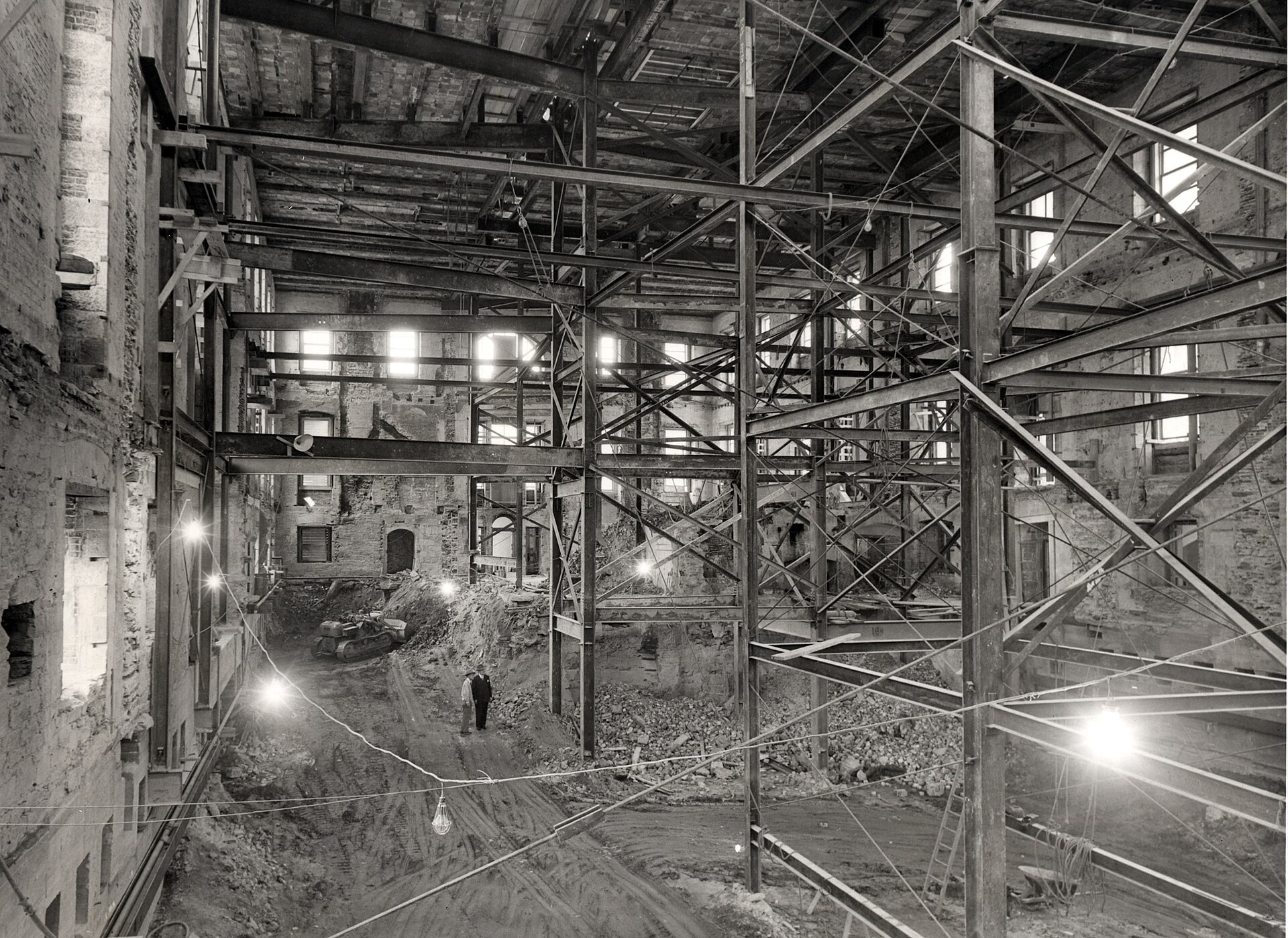
The interior completely gutted during the Truman reconstruction, about 1950. Photo: Abbie Rowe, National Park Service, public domain, via Wikimedia Commons. Resized.
2025-2026: the East Wing comes down
The largest change since Truman is happening now. In October 2025, demolition crews tore down the East Wing - home since 1902 to the first lady's offices, the family theater and the public tour entrance - to clear ground for a new state ballroom above a rebuilt military complex beneath. In 2026 the North Portico's facade was repaired and restored. Public tours, which traditionally entered through the East Wing, were suspended in late August 2025; officials have said they expect tours to resume on an updated route once construction allows. (Read November 5, 2026 - check current status before planning a visit.)
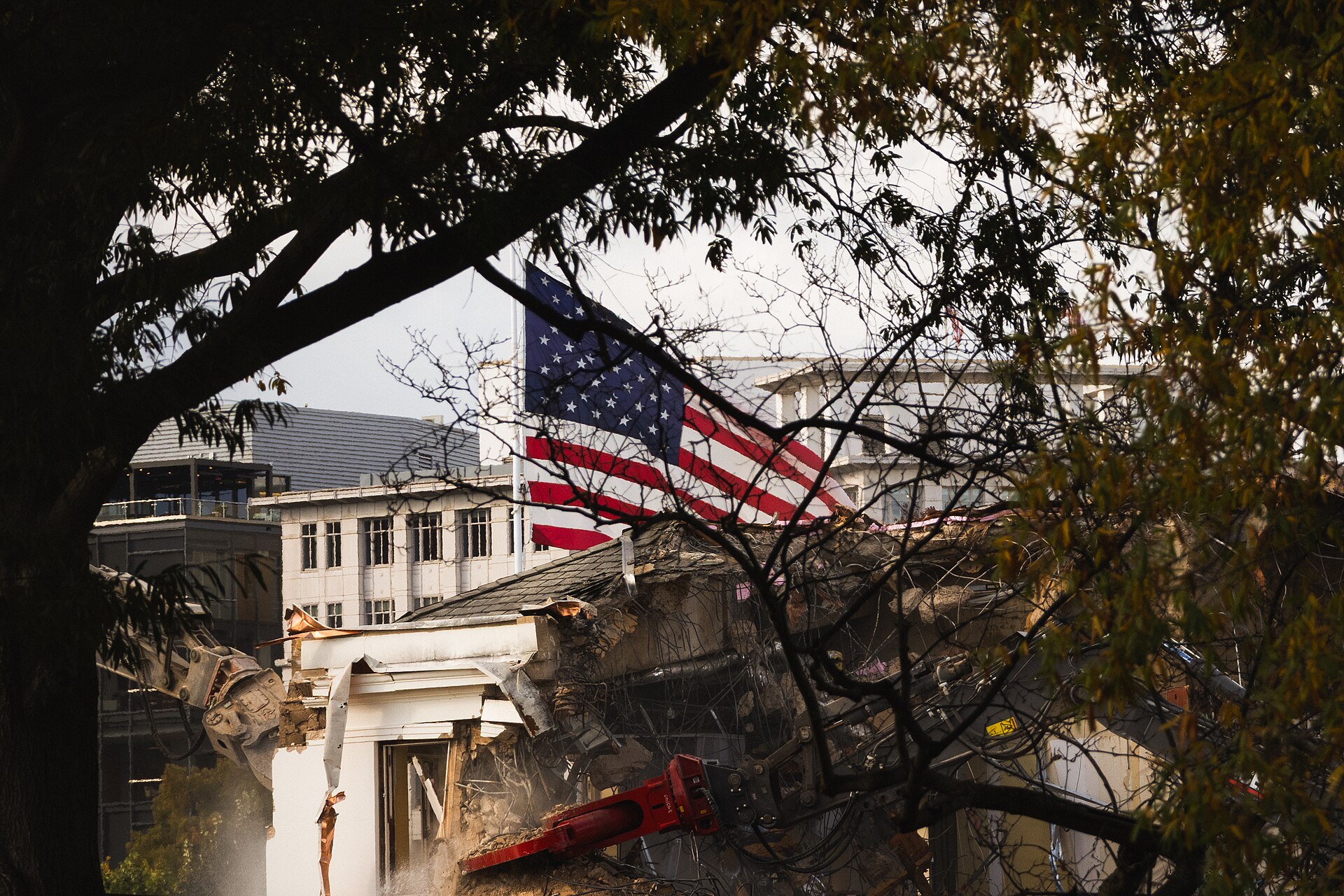
The East Wing demolition underway, October 22, 2025. Photo: Hassan Albadawi, CC BY-SA 4.0, via Wikimedia Commons. Resized.
Who owns the White House today?
The White House is owned by the United States. It is both the president's home and workplace and part of President's Park, which the National Park Service administers; the Executive Residence staff run the house itself, and every change to the State Rooms must pass the Committee for the Preservation of the White House.
In the movies
No film crew gets to shoot inside the real State Rooms, so every movie White House is a reconstruction. The most famous is the smallest: Independence Day (1996) blew up a detailed miniature five feet high and fourteen feet wide, packed with dollhouse furniture so the debris would read as real - a shot that became the film's worldwide poster. Olympus Has Fallen (2013) built a full-scale White House replica on an empty lot in Bossier City, Louisiana, dressing a parkway to pass for Pennsylvania Avenue. Real footage of the house is generally limited to exteriors shot from the fences and Lafayette Square.
Where can you eat or drink near the White House?
There is no public dining at the White House. The closest taste of the place is The People's House: A White House Experience, the White House Historical Association's free interactive museum just steps from the East Gate, across from the Eisenhower Executive Office Building - with a full-scale Oval Office replica and an immersive state-dinner room. The blocks around Lafayette Square, including the storied Old Ebbitt Grill two blocks east, handle the actual eating.
Visiting the White House
- Address: 1600 Pennsylvania Avenue NW, Washington, DC 20500
- Hours: Tours Tuesday-Saturday, 8 AM-12:30 PM (when offered)
- Admission: Free (request through your Member of Congress)
Public tours must be requested through a Member of Congress, ideally 3 weeks to 3 months ahead. Without a tour, the best views are from Pennsylvania Avenue (north side) and the Ellipse (south side).