The Supreme Court Building: A Marble Temple, 145 Years Late
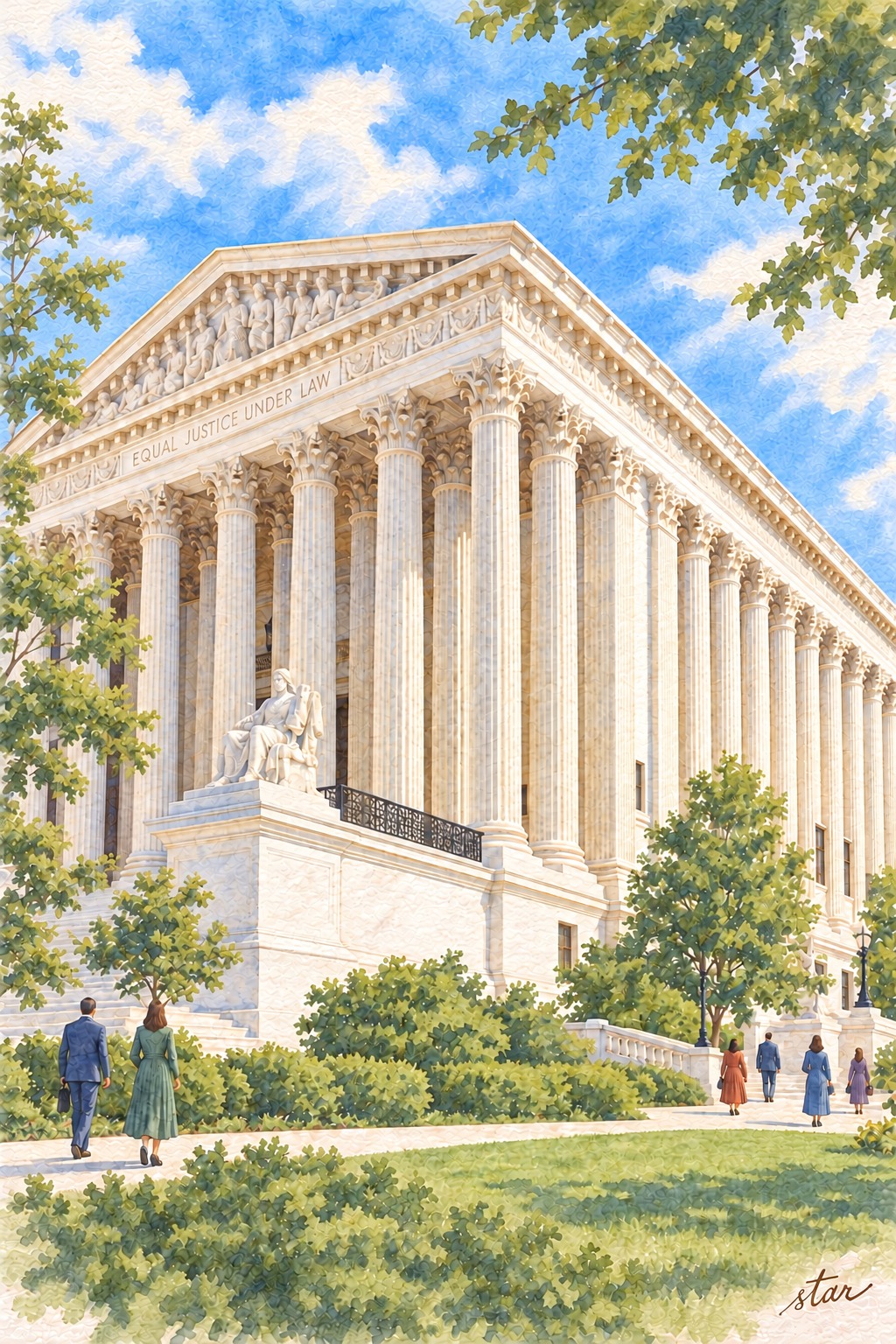
Original watercolour art illustration by Solomon Rokowsky.
For its first century and a half the Supreme Court was a tenant. It began in New York's Merchants Exchange in 1790, followed the capital to Philadelphia's Old City Hall, and arrived in Washington in 1800 with no courtroom of its own at all, borrowing rooms in the Capitol for its first decade in the city. From 1810 it sat in Benjamin Henry Latrobe's vaulted chamber in the Capitol basement, and from 1860 in the vacated Old Senate Chamber, where the justices worked in what Charles Evans Hughes called small, overheated and barren quarters, mostly writing from home.
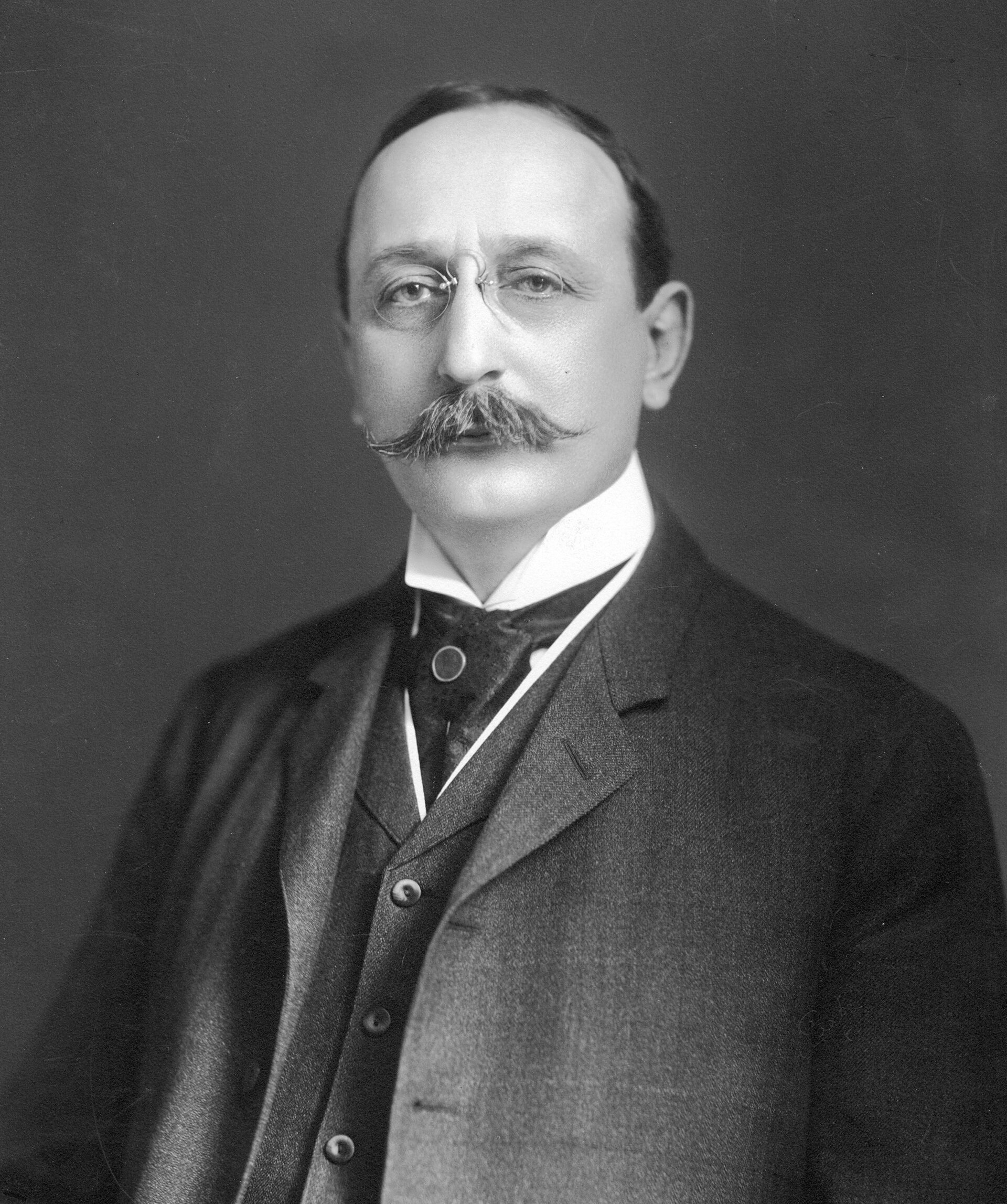
The building exists because of one man who knew both branches. William Howard Taft proposed a Supreme Court building as President in 1912, then took up the cause again as Chief Justice in 1921, arguing the judiciary needed its own house as a coequal branch. He lobbied Congress for years against real resistance - some justices, including Brandeis and Stone, saw no reason to leave the Capitol - and in 1929 he won the funding. The site, across First Street from the Capitol, had previously held the Old Capitol Prison and the headquarters of the National Woman's Party, which was bought and razed.
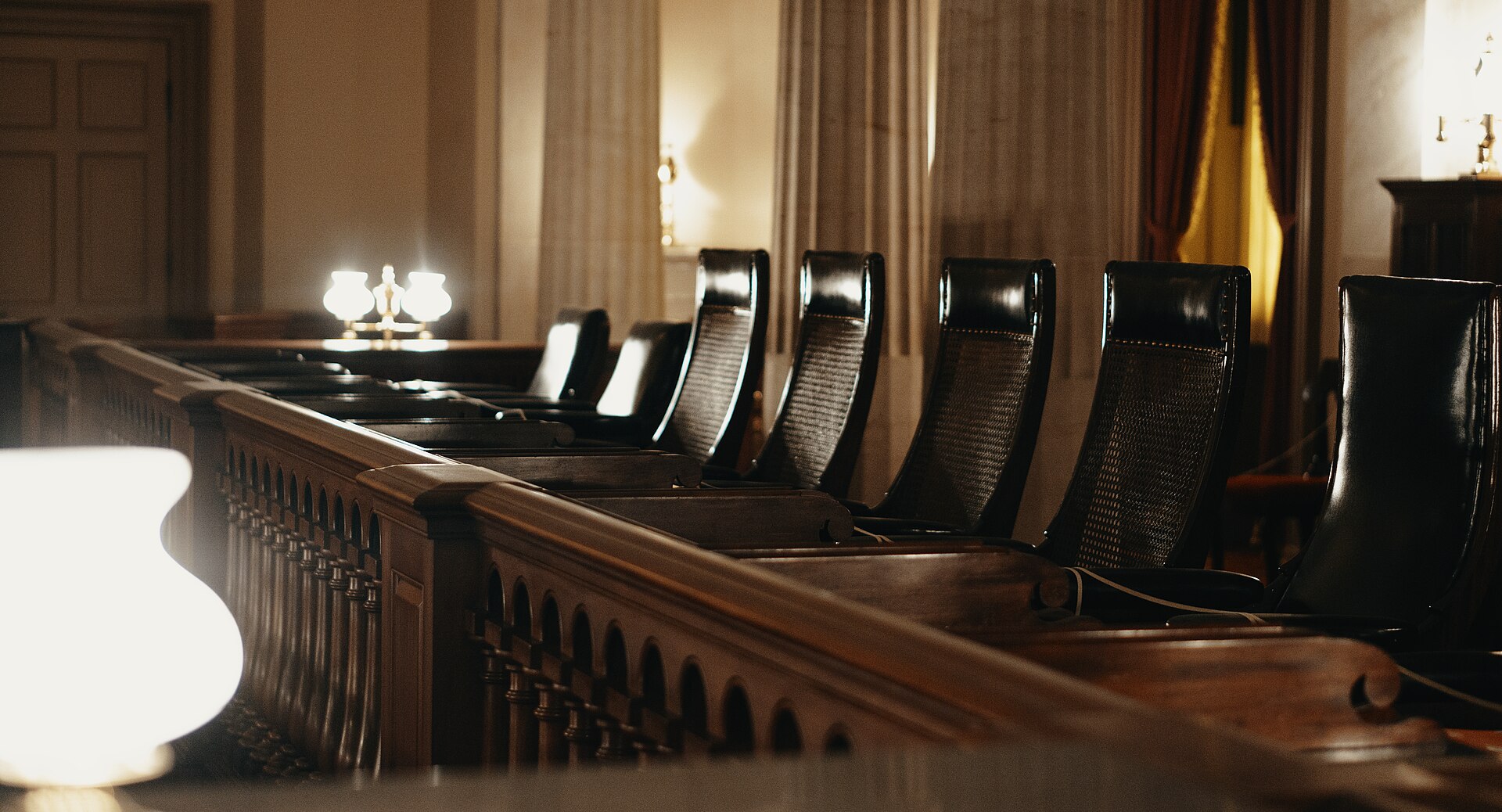
Latrobe's Old Supreme Court Chamber in the Capitol, the Court's home from 1810 to 1860. Photo: Michael Savidge, CC BY 4.0, via Wikimedia Commons. Resized.
Cass Gilbert's temple of law
Taft personally chose Cass Gilbert - architect of New York's Woolworth Building - charging him to design "a building of dignity and importance suitable for its use as the permanent home of the Supreme Court of the United States." The cornerstone was laid on October 13, 1932, and the building was completed in 1935 for slightly under the $9.74 million Congress authorized. Gilbert died in 1934; his son Cass Gilbert Jr. finished the work. The public faces are Vermont marble, the courtyards Georgia marble, the interiors Alabama marble - and for the courtroom's 24 columns Gilbert would accept only ivory-gold marble from Siena, Italy, writing personally to Mussolini in 1933 to ask that the quarries send nothing inferior to the sample.
The seventeen-foot bronze doors, cast by the General Bronze Corporation, carry bas-reliefs of the history of justice; their sculptor John Donnelly Jr. said they were the only work his firm ever signed. Over the west facade runs "Equal Justice Under Law," over the east "Justice, the Guardian of Liberty." Inside the courtroom, friezes parade eighteen great lawgivers - Menes, Hammurabi, Moses, Solomon, Confucius, Justinian, Muhammad, Blackstone, Marshall, Napoleon among them. In 1997 the Council on American-Islamic Relations asked that the Muhammad figure be removed; Chief Justice Rehnquist declined, saying the sculpture honors him as one lawgiver among many.
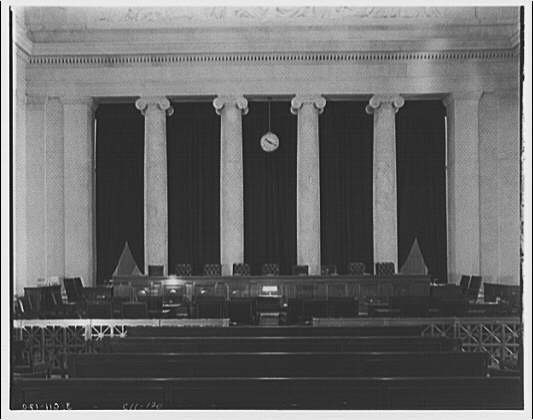
The courtroom, with its 24 columns of ivory-gold Siena marble. Photo: Theodor Horydczak, public domain, via Wikimedia Commons. Resized.

The courtroom's west frieze, with lawgivers from Menes to Augustus. Photo: Supreme Court of the United States, public domain, via Wikimedia Commons. Resized.
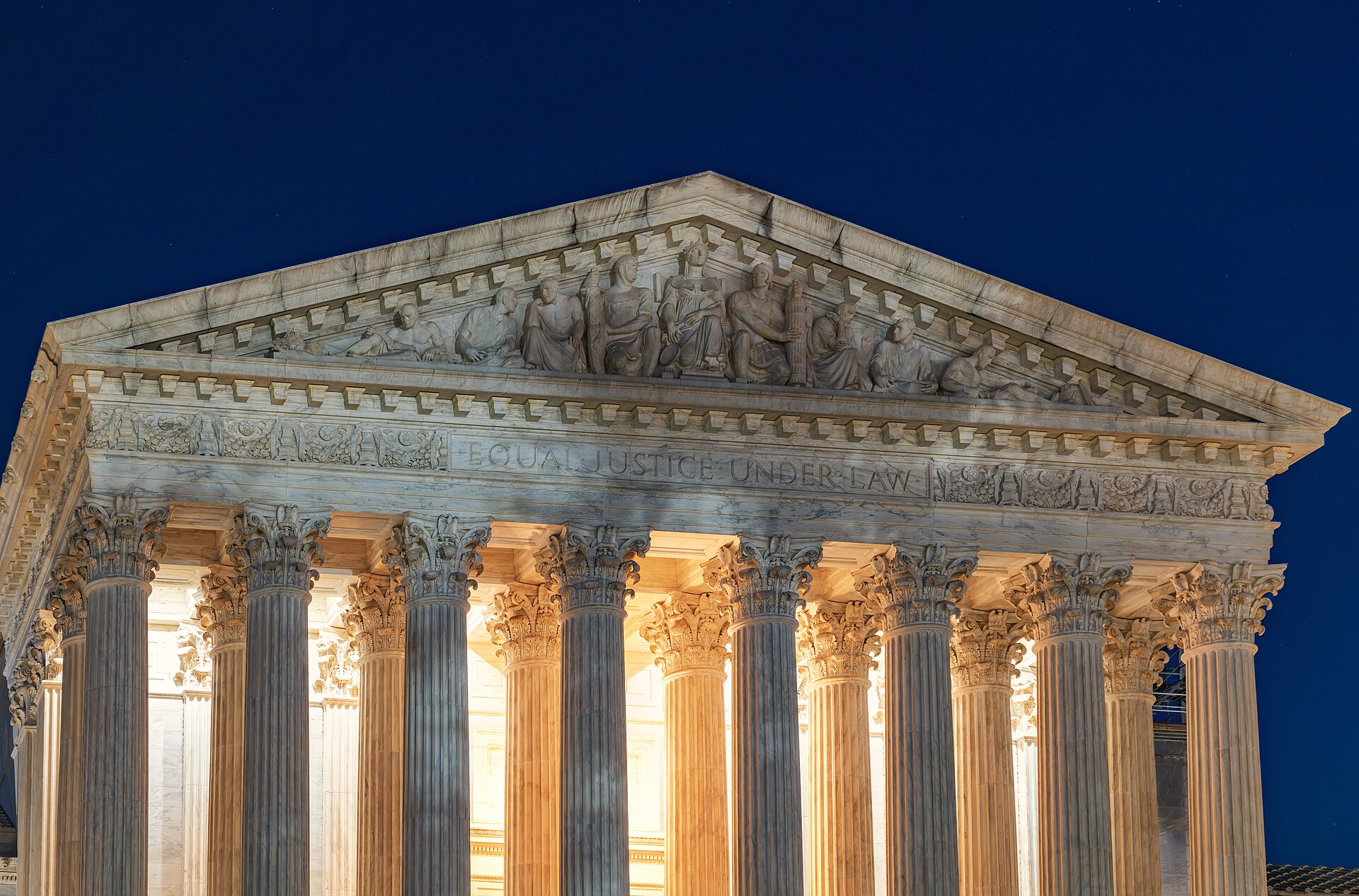
"Equal Justice Under Law" over the west entrance. Photo: Tony Webster, CC BY 2.0, via Wikimedia Commons. Resized.
Nine black beetles
Not everyone loved the marble palace. Justice Harlan Fiske Stone called the courtroom "almost bombastically pretentious," and another justice grumbled that the Court would look like "nine black beetles in the Temple of Karnak." Stone and Brandeis never moved their work into the building. The justices' lighter side lives on the fifth floor: a gym with a basketball court known as the "Highest Court in the Land," where Byron White - a 1937 Heisman runner-up - once played, and where a sign warns that basketball is prohibited while the Court is in session. In 2005 a 172-pound chunk of marble fell four stories from the west facade, prompting a full restoration completed in 2013. And since 2010, for security, visitors no longer enter up the great front steps - a change Justices Breyer and Ginsburg publicly called dispiriting.
Who owns the Supreme Court Building today?
The building is owned by the United States and occupied by the Supreme Court as its permanent home - the first it has ever had. It has been protected since 1935 by its own police force, the Supreme Court Police, separate from the Capitol Police.
In the movies
No camera has ever filmed inside the courtroom - recording devices of any kind are banned - so screen courtrooms are always sets. The building itself does get location work: The Pelican Brief (1993) filmed on the Supreme Court's steps during its Washington shoot, and the facade appears in the Washington montage of Mr. Smith Goes to Washington (1939). When you watch a Supreme Court argument on screen, you are looking at a production designer's copy.
Where can you eat or drink at the Supreme Court?
The Supreme Court Cafe on the ground floor is open to the public from 9 a.m. to 3 p.m., Monday through Friday - one of the few public cafeterias in a federal landmark on Capitol Hill, with sandwiches, salads, pizza and Starbucks coffee. (Hours read November 5, 2026; confirm before visiting.)
Visiting the Supreme Court Building
- Address: 1 First St NE, Washington, DC 20543
- Hours: Monday-Friday, 9 AM-4:30 PM (court days vary)
- Admission: Free
When the Court is in session, visitors can attend oral arguments on a first-come, first-served basis. The ground-floor exhibits and the courtroom lecture are open on non-argument days.