The Lincoln Memorial: A Greek Temple for a Rail-Splitter
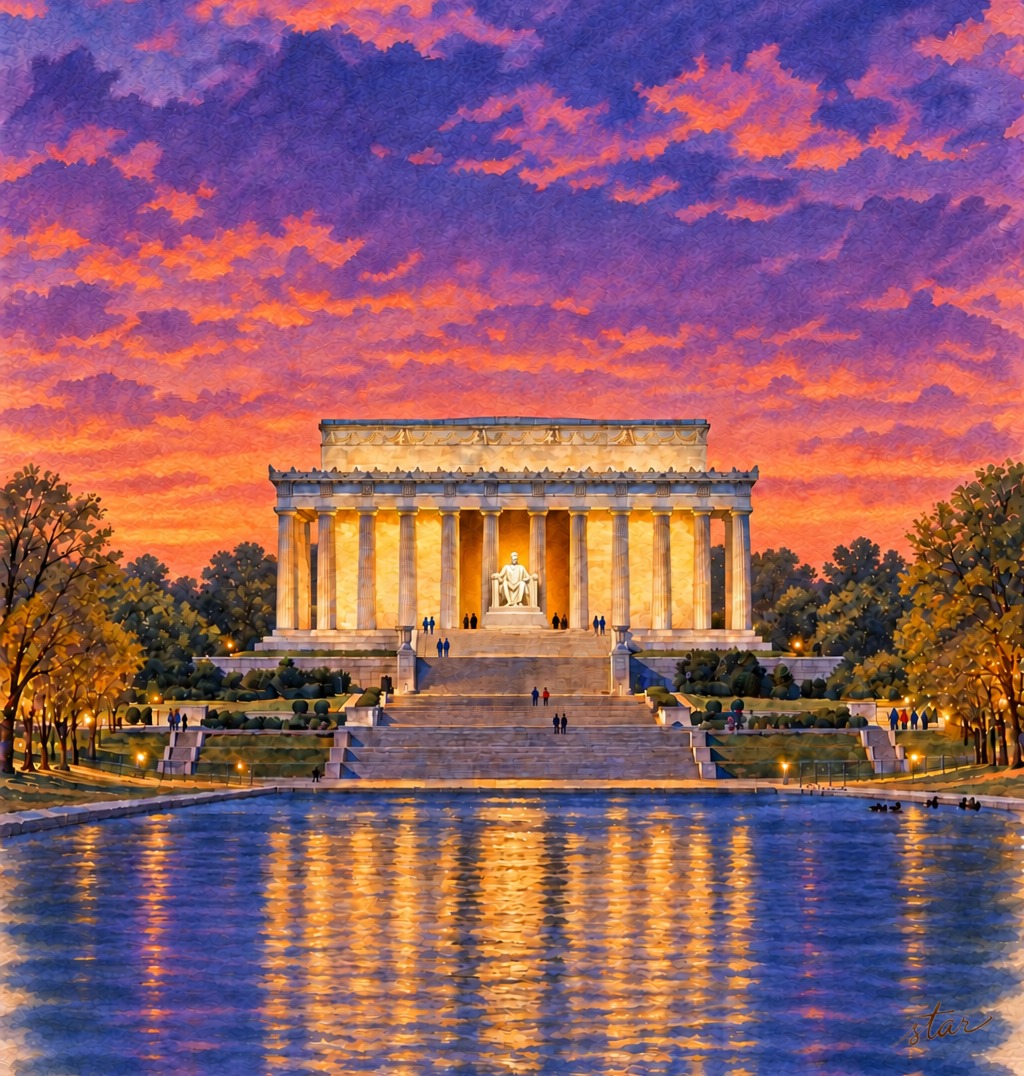
Original watercolour art illustration by Solomon Rokowsky.
Washington began promising Lincoln a memorial almost before he was buried: Congress voted a commission in 1867, and the designer Clark Mills proposed a 70-foot pile of statues crowned by a 12-foot Lincoln. Nobody paid for it, and the idea slept for forty years. Six bills died in the early 1900s - Speaker Joe Cannon hated the project - before the seventh passed in December 1910. President William Howard Taft chaired the memorial commission himself.
The commission's choices were fought over from both directions. Henry Bacon's design, a Greek Doric temple, struck many as far too grand for the prairie president; critics proposed a humble log-cabin shrine instead. The site, freshly reclaimed swampland in West Potomac Park, was called too marshy and too remote. The commission held firm: the ground sat exactly on the axis running from the Capitol past the Washington Monument, and the 1901 McMillan Plan had already reserved it for a great memorial. Ground was broken on Lincoln's birthday, February 12, 1914.
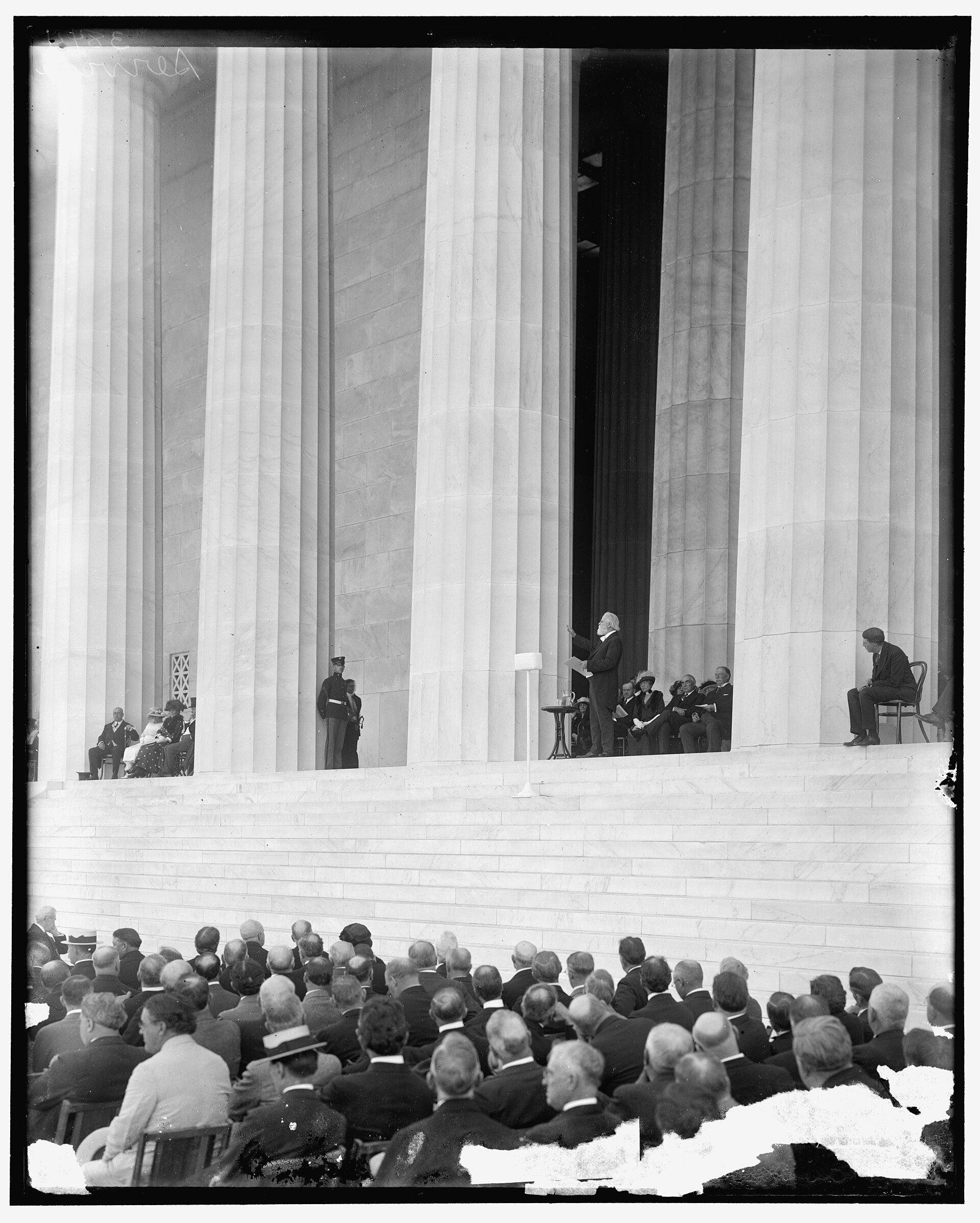
The dedication, May 30, 1922. Photo: Harris & Ewing, public domain, via Wikimedia Commons. Resized.
Building the temple
The memorial is built of Yule marble from Colorado, ringed by 36 fluted Doric columns - one for each state in the Union when Lincoln died - with the 48 states of 1922 inscribed on the attic frieze above. There are 87 steps up from the Reflecting Pool, a deliberate echo of "four score and seven years ago." Inside, Daniel Chester French's seated Lincoln was carved by the six Piccirilli brothers from 28 blocks of Georgia white marble; it was planned at 10 feet tall and doubled to 19 so the huge chamber would not dwarf it. Had French stood him up, this Lincoln would be 28 feet tall. On the side walls are the Gettysburg Address and the Second Inaugural, with murals by Jules Guerin; above the statue runs Royal Cortissoz's epitaph: "In this temple, as in the hearts of the people for whom he saved the Union, the memory of Abraham Lincoln is enshrined forever."
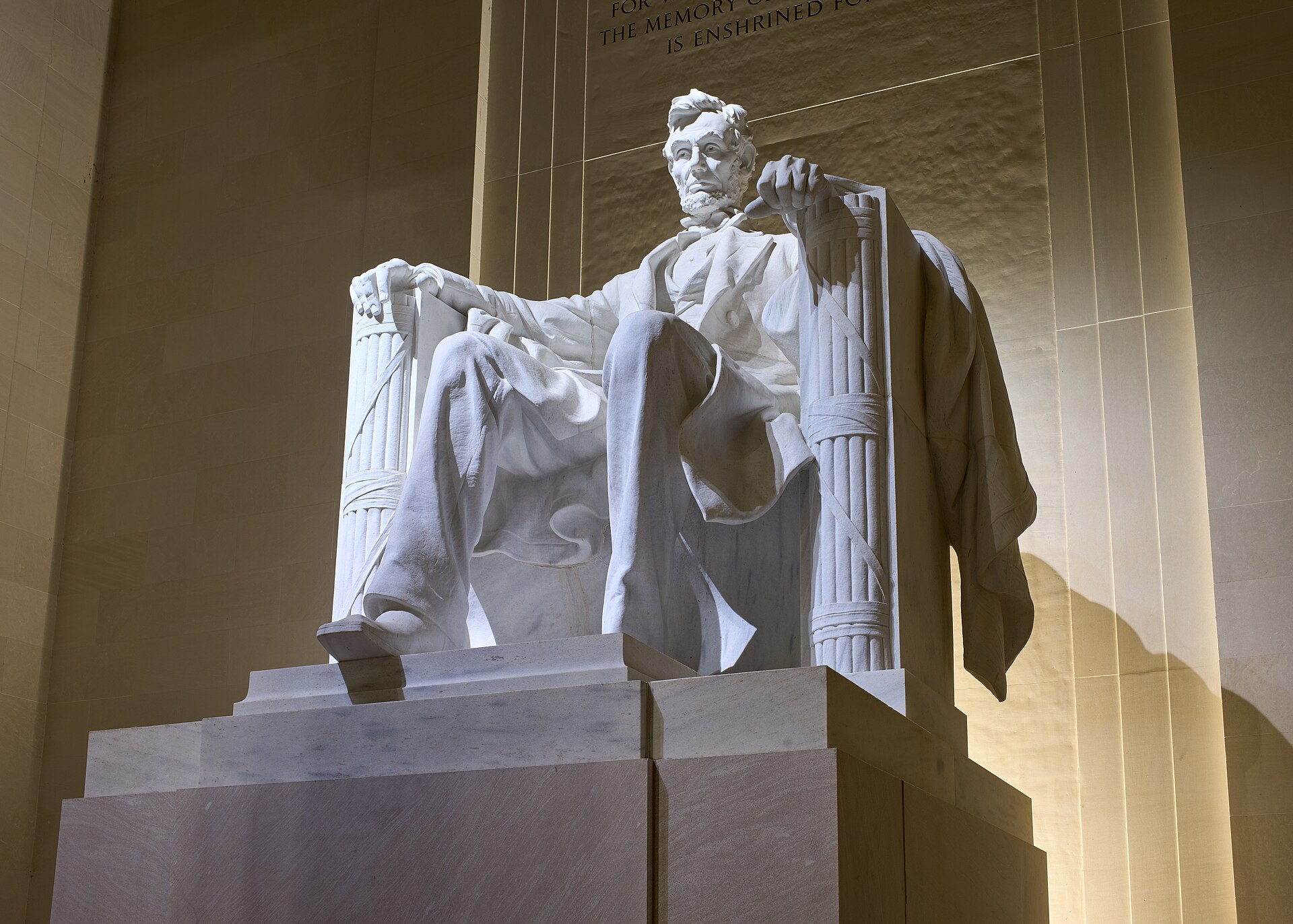
Daniel Chester French's seated Lincoln. Photo: Frank Schulenburg, CC BY-SA 4.0, via Wikimedia Commons. Resized.
Chief Justice Taft dedicated the memorial on May 30, 1922, presenting it to President Warren G. Harding. Robert Todd Lincoln, the president's 78-year-old son, attended. Black guests invited to the ceremony found themselves seated in a segregated section guarded by Marines - a beginning as conflicted as the nation the memorial serves.
America's front steps
The memorial became the country's stage for conscience. In 1939, after the Daughters of the American Revolution refused Constitution Hall to Marian Anderson because she was Black, Eleanor Roosevelt and Interior Secretary Harold Ickes moved her concert to the memorial's steps; 75,000 people stood before it on Easter Sunday, with millions more on radio. On August 28, 1963, a quarter of a million people came to the March on Washington, and Martin Luther King Jr. gave his "I Have a Dream" speech from the steps; the exact stone where he stood was engraved in 2003. In May 1970, days after Kent State, Richard Nixon made a strange, sleepless 4 a.m. visit to talk with student protesters camped at the memorial.
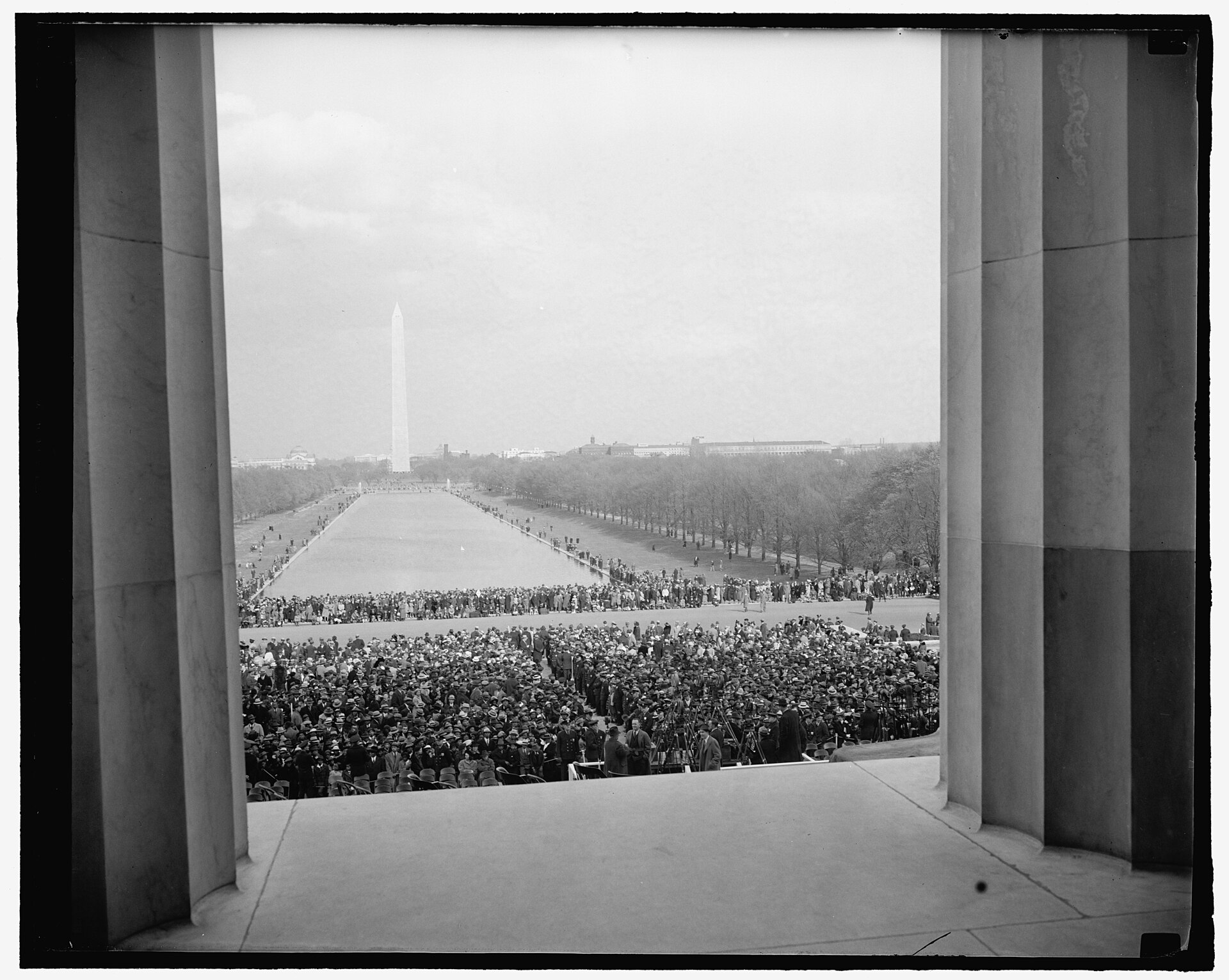
Marian Anderson's concert on the steps, Easter Sunday 1939. Photo: Harris & Ewing, public domain, via Wikimedia Commons. Resized.
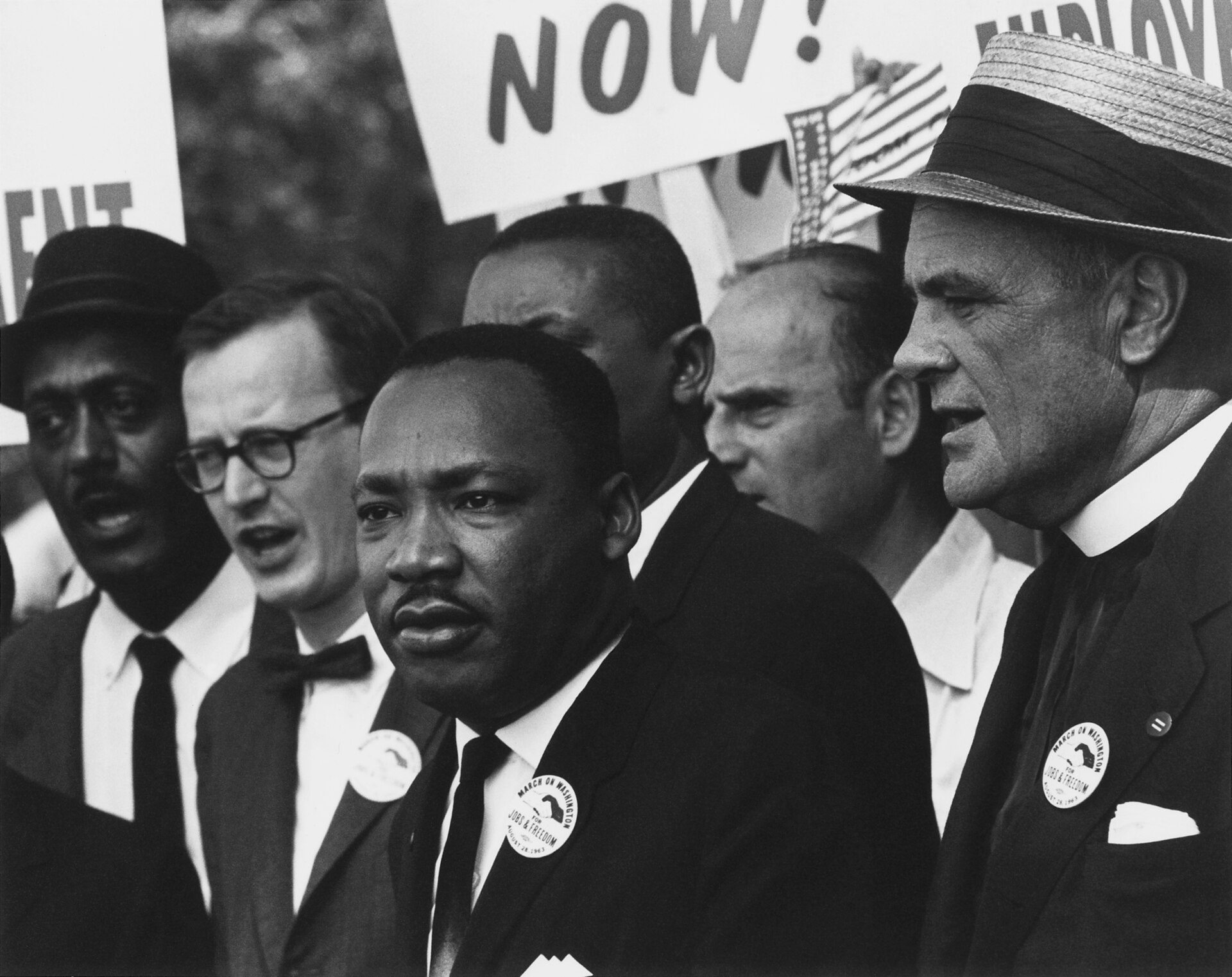
Martin Luther King Jr. at the March on Washington, August 28, 1963. Photo: Rowland Scherman, U.S. Information Agency, public domain, via Wikimedia Commons. Resized.
Legends, and the room underneath
Two legends cling to the statue: that Robert E. Lee's face is carved into the back of Lincoln's head, and that the hands spell "A-L" in American Sign Language. The National Park Service denies the first outright; on the second, historians note French knew sign language and had a deaf son, so it cannot be ruled out - but no document proves intent. Beneath your feet is the undercroft, a cathedral-like forest of columns where workmen's century-old graffiti and slow-growing stalactites survive. A $69 million rehabilitation funded by David Rubenstein turned part of it into a museum about the memorial's construction and meaning; it opened to the public on June 25, 2026, with timed-entry reservations.
Who owns the Lincoln Memorial today?
The memorial belongs to the United States and is administered by the National Park Service as part of National Mall and Memorial Parks. Admission is free.
In the movies
The Park Service is strict here: filming is prohibited above the white marble steps and inside the chamber, so most "memorial" scenes on screen are digital. The great exception is also the great story: for Mr. Smith Goes to Washington (1939), Frank Capra was refused permission to film inside, so he sent a large crew off as a decoy while a small one slipped James Stewart and Jean Arthur into the memorial - the scene where the statue steadies Senator Smith was genuinely shot there. Forrest Gump (1994) spliced Tom Hanks into the anti-war rallies on the steps. In Transformers: Dark of the Moon (2011), Megatron shoves the Lincoln statue off its chair and takes the throne - effects work, not location shooting.
Where can you eat or drink near the Lincoln Memorial?
There is no cafe or food service at the memorial itself - plan to eat before or after, around the Mall or back toward Foggy Bottom and downtown. Water bottles are the one thing worth carrying in summer.
Visiting the Lincoln Memorial
- Address: 2 Lincoln Memorial Cir NW, Washington, DC 20002
- Hours: Open 24 hours; rangers on duty 9:30 AM-10 PM
- Admission: Free
The memorial is at the west end of the National Mall. The nearest Metro stops are Foggy Bottom-GWU and Arlington Cemetery, each about a 15-20 minute walk. Evenings are quieter and the lighting is beautiful.